

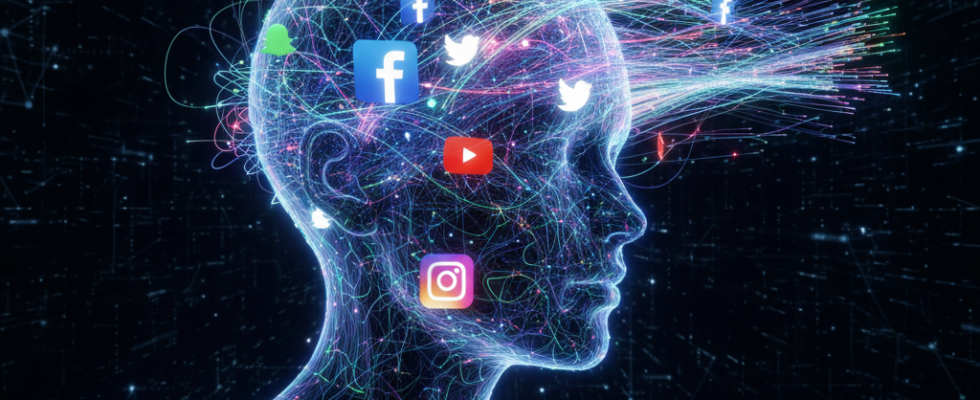
When that documentary about social media manipulation aired in 2020, people shared it widely on social media without irony. The awareness it created was real but ultimately behavioral change was minimal. We understood the manipulation and kept scrolling anyway. Six years later, the research on what prolonged exposure has actually done to cognitive patterns is far more unsettling than the documentary’s warnings suggested.
Advertisements
Attention spans have measurably shortened, but not in the simple way the headlines suggest. What has changed is not the ability to focus, which remains largely intact for genuinely engaging tasks, but the tolerance for tasks that do not provide immediate feedback. The brain has adapted to constant reward signals and now experiences their absence as discomfort rather than neutrality. Boredom has become genuinely painful in ways previous generations did not experience.
Memory formation has shifted. Research indicates that people retain less from content they consume digitally because the brain codes it as externally stored rather than personally important. Why remember something when you can search for it? This adaptive efficiency becomes problematic when it extends to personal experiences and conversations that should be encoded but are instead treated as retrievable data.
Social cognition has altered in measurable ways. The ability to read emotional cues in face-to-face interaction has declined among heavy social media users because the platforms train pattern recognition for text-based emotional signals rather than the subtle physical ones that human communication evolved to use. People are becoming fluent in digital emotional language while losing proficiency in embodied emotional reading.
The comparison circuits in the brain have been dramatically overactivated. Humans always compared themselves to others, but the comparison set was historically limited to immediate peers. Social media expanded that set to include the most exceptional performers on earth, creating a baseline for self-evaluation that no normal life can satisfy. The resulting dissatisfaction is not a character flaw. It is a predictable neurological response to unprecedented comparison volume.
Sleep architecture has changed population-wide. The blue light argument is the least interesting part of this story. More significant is the arousal state that scrolling maintains. The nervous system stays activated by the unpredictable reward schedule of content feeds, making the transition to sleep readiness longer and less complete than it was in the pre-smartphone era.
None of this is irreversible. Neuroplasticity works in both directions. People who intentionally restructure their digital habits show measurable cognitive recovery within weeks. But the recovery requires intention that the platforms are specifically designed to undermine. The dilemma was never really about whether we understood the problem. It was about whether understanding would be enough to change behavior when the systems are engineered to prevent exactly that change.