

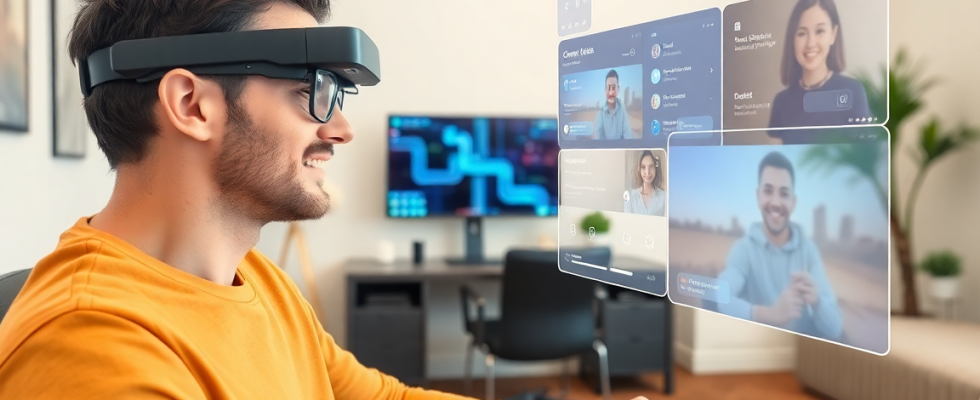
In the rapidly evolving landscape of remote work, augmented reality (AR) glasses are revolutionizing how professionals collaborate and interact over distances. These smart devices are designed to overlay digital information onto the real world, providing seamless and efficient remote visual assistance. As the demand for remote collaboration grows, especially in the United States, AR glasses are becoming indispensable tools for various industries. This article explores the top models of AR glasses that are ideal for remote collaboration, their features, and how they can enhance productivity in the workplace.
Advertisements
The Rise of AR Glasses in Remote Work
Augmented reality glasses have transitioned from being a futuristic concept to a practical tool for enhancing remote collaboration. As businesses adapt to hybrid and remote work models, the need for efficient communication tools has become more critical than ever. AR glasses offer hands-free operation, allowing users to interact with digital content while maintaining awareness of their physical surroundings. This capability is particularly valuable in industries such as manufacturing, healthcare, and engineering, where real-time data and visual information are crucial.
Top Models for Remote Collaboration
Xreal One Pro and Xreal 1S
The Xreal One Pro and Xreal 1S are among the leading AR glasses models designed for remote work. These devices are known for their lightweight design and high-resolution displays, making them ideal for professionals who need to interact with detailed digital content. The Xreal 1S, in particular, offers a wide field of view, which enhances the user's ability to engage with multiple data points simultaneously. Both models support various applications, from video conferencing to interactive training sessions, making them versatile tools for remote collaboration.
Viture Luma Ultra and Viture Beast XR
Viture's Luma Ultra and Beast XR are powerful contenders in the AR glasses market, designed with advanced features to support remote collaboration. The Luma Ultra is equipped with high-definition optics and intuitive gesture controls, allowing users to manipulate digital content seamlessly. The Beast XR takes it a step further with its robust processing power and extended battery life, ensuring uninterrupted use during long remote meetings or fieldwork. These models cater to professionals who require high-performance devices for complex tasks and data analysis.
RealWear and Epson Moverio
RealWear AR glasses are specifically engineered for industrial use, with a focus on safety and productivity. These hands-free devices are powered by AI-voice commands, enabling workers to access information and communicate without physical interaction. RealWear glasses are particularly useful in hazardous environments where hands-on tasks are required. On the other hand, Epson Moverio offers a more office-oriented solution, with its lightweight design and high-resolution display. Moverio glasses excel in environments where visual clarity and precision are essential, such as design and architecture.
Moziware and Rokid
Moziware and Rokid are emerging players in the AR glasses market, offering innovative solutions for remote work. Moziware glasses are designed with ergonomics in mind, ensuring comfort during extended use. They provide a balance of functionality and style, making them suitable for professionals in creative fields. Rokid, known for its advanced AI integration, offers a range of smart glasses that enhance collaboration through real-time language translation and facial recognition features. These capabilities make Rokid glasses particularly appealing in global business settings where cross-cultural communication is frequent.
Enhancing Productivity and Collaboration
The integration of AR glasses in the workplace is transforming how teams collaborate and manage workflows. By enabling hands-free access to information and real-time data sharing, these devices significantly reduce the time spent on manual tasks and improve overall efficiency. For instance, in the healthcare sector, AR glasses can assist surgeons by overlaying critical patient data during operations, thus reducing the risk of errors. In manufacturing, technicians can receive step-by-step guidance through AR overlays, minimizing downtime and enhancing productivity.
Moreover, AR glasses facilitate immersive training experiences, allowing employees to learn new skills in a virtual environment that simulates real-world conditions. This approach not only accelerates the learning process but also enhances retention by providing interactive and engaging training modules.
Challenges and Considerations
While AR glasses offer numerous benefits, their adoption in remote work settings is not without challenges. One significant consideration is the cost of these devices, which can be prohibitive for small businesses. Additionally, the integration of AR technology requires a robust IT infrastructure and support system to ensure seamless operation. Privacy and security concerns are also paramount, as AR glasses often involve capturing and transmitting sensitive data.
To address these challenges, companies should conduct thorough assessments of their specific needs and select AR glasses that align with their operational goals and budget constraints. Training and support should be provided to employees to maximize the potential of these devices and ensure a smooth transition to AR-enhanced workflows.
Conclusion
AR glasses are poised to become a staple in the toolkit of modern professionals, offering unparalleled opportunities for remote collaboration and productivity enhancement. As the technology continues to evolve, the range of applications and capabilities of AR glasses will expand, providing even greater value to businesses. For companies in the United States looking to stay ahead of the curve, investing in top AR glasses models like Xreal, Viture, RealWear, and others can pave the way for a more connected and efficient workforce. By embracing this cutting-edge technology, organizations can foster a culture of innovation and adaptability, essential traits in today's dynamic work environment.