

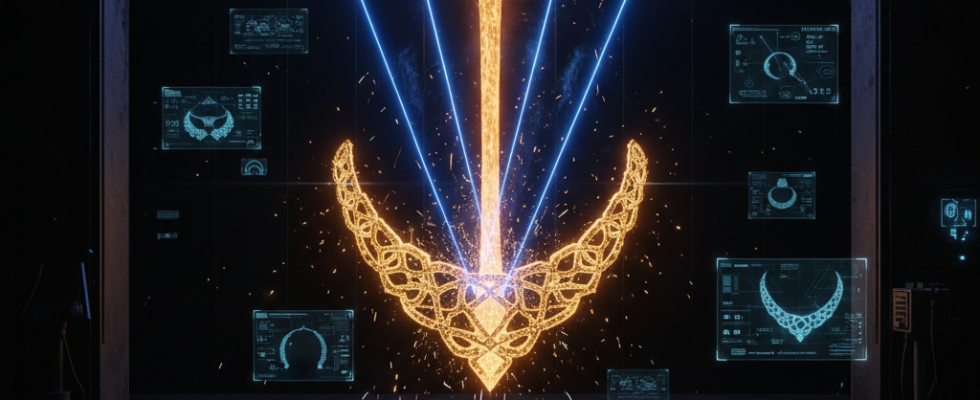
The necklace I am wearing right now does not exist anywhere else on earth. Not because it is vintage or one-of-a-kind in the traditional sense. Because it was designed on a screen, printed in wax, cast in gold, and finished by hand specifically for my neck, my proportions, my aesthetic preferences. It took four days from concept to delivery. A decade ago, this level of customization would have required a private jeweler and a budget most people cannot imagine.
Advertisements
3D printing has quietly demolished the barriers between imagination and wearable reality in jewelry design. What once required months of hand-carving wax models and extensive back-and-forth with artisans now happens through intuitive design interfaces where you manipulate shapes, adjust proportions, and see your creation rendered photorealistically before committing to production.
The technology works through lost-wax casting, a technique that is actually ancient, but with a modern twist. A 3D printer creates a precise wax model of your design. That model is encased in plaster, heated until the wax melts away, and then filled with molten metal. The result is a piece with the geometric precision of digital design and the material warmth of traditional craftsmanship.
Customization is the obvious appeal, but it is not the only one. 3D printing enables geometries that would be impossible to create by hand. Interlocking structures, internal lattices, organic forms inspired by mathematics and nature that no human hand could carve at jewelry scale. The technology expands what jewelry can be, not just who can afford custom pieces.
Independent designers are thriving in this space. Without the overhead of traditional manufacturing, a designer with talent and a 3D printer can compete with established brands on quality while offering personalization that large companies cannot logistically provide. The playing field has genuinely leveled.
Materials have expanded beyond precious metals. Ceramic, titanium, recycled plastics transformed into gem-like resins, and hybrid materials that combine multiple properties in a single piece. The constraint is no longer “what can we make?” but “what can we imagine?”
The most compelling promise is emotional. Jewelry has always been personal. But a piece designed by you, for you, carrying your creative decisions in every curve and angle, has a different weight than something chosen from a display case. It is yours in a way that mass-produced objects, however beautiful, can never quite be.